



The Tay, Source to Sea by CanoeThree Guys, one Gal and a dog called WobbleSaturday morning in October, phone rang at 9am (OK I was still in bed). "Would I like to cross Scotland by Canoe in 4 days starting on Tuesday"? Er em Yes! Route revised to do the Tay confluence, source to sea. Apparently it takes 440 days for a drop of water that falls on Ben Lui to reach Dundee. 420 days are spent getting through Loch Tay. We wanted to learn and test journeying skills such as lining, tracking, poling, sailing and general ropework. Accommodation would be in bivis with the sail doubling up as a sociable tarp using the canoes as walls. At Dalrigh, near Tyndrum, the road turned to track. We put the the two canoes and a pack on the trolley for the walk to Ben Lui and the top of River Cononish. Result was one collapsed trolley! One of the party was an outdoor instructor and hobbies included testing gear to destruction! We opted to put in at this point and save the Ben Lui start for another trip. (We didn't see the top of the River Cononish but it is possibly not suitable for open canoes and may even be difficult to line) On the water The
Accommodation On the water about 10.30am on Wednesday morning. The paddle towards Killin was meandering with plenty of time to admire the many surrounding Munros. Wobble the dog, would often be dropped off on the bank to have a run and get off the water. Wobble doesn't like water, particularly rapids!
The Dochart
Falls We paddled and lined our way down the top part of the rapids becoming quite slick with the coaching from Ash - prepare bow and stern ropes, bridle, paddle down rapids, must make break out, jump onto rock, line down drop, back in boat, ferry glide across to tiny eddy jump out, line down, rest. The crux was next. A tricky powerful chute with a diagonal wave and a large rock blocking bank access and movement downstream with the rocky bank slippy and slopping towards the river. Within 5 minutes the first canoe had broached and was pinned hull downstream against a large flat midstream rock. Fortunately we had retained both the stern and bow ropes. The gear was secured in two large dry/portage sacs which meant that the gear was safe and also kept a lot water out of the boat. By now we had attracted a lot of interest on the bank with the Killin coach parties having a field day! The Rescue Very soon the canoe showed signs of movement. Encouraged we put on more strain. The canoe slipped off the rock. It was now back in the flow but still in danger because it was under tension from the other rope and side on to the current. One of us ran over to the rope attached to the tree. It was too tight to loosen quickly. Ash shouted "Cut it", this will look cool I thought - Pull the knife off the buoyancy aid and slash rope….or not, oops …non cutting edge…...turn the knife round and ping. The coach parties would really be able to dine out on this. The photographer had missed his chance, repacked and trudged off disconsolately. The canoe was pulled ashore and the damage inspected. The gunwales were badly bent from where the canoe had broached upstream of the pin. The hull had a couple of ripples but was otherwise fine. A couple of kicks and the gunwale was back in reasonable shape. Next the gear, sleeping bags etc. The Sealline 115 litre boundary bags were bone dry. I was impressed. The trip was still on. The Cause We believed the pin which lasted about 45minutes caused little or no damage. The downstream line had not been caught by the downstream person because of line of sight problems anso there was no pull on the canoe which may have kept it on line better. Learnings Plan B We launched onto the River Lochy and made our way onto Loch Tay in the dark. It was a lovely still night for a paddle. We decided to head over to the south shore and began looking for a camp spot and at 8.30pm found one in a clearing east of Firbush point. 2 on food and 2 on accommodation and 1 on sniffing. Very soon we had a cosy camp eating lovely pizzas. The Sail
A quick demasting stop at Kenmore before heading down the lovely bumpy stretch to Grandtully. Some rapids were difficult enough without Wobble moving along the gunwhales from the bow to the middle of the canoe in mid rapid! Fast Progress A quick snack. It was 5pm and we decided to push on and get to Dunkeld or possibly Campsie Linn before stopping. Progress continued at pace. By 7pm we were at Dunkeld and we decided to call it a day pitching camp in the dark and rain on the left hand bank soon after.A slick pitch and we were soon snug under the tarp. Decision
time Poor Wobble was in shock and kept falling asleep. We were confident that there were no rapids of consequence before Campsie nevertheless water makes a noise out of all proportion in the dark. At 6am we rafted up for breakfast and caught the sunrise as we passed the Isla confluence. Campsie was
lined. Ominously we had felt the start of a head wind and after
running the Stanley to Thistlebrigg section we knew the game was
pretty much up. Energy was low after yesterday's 59km paddle and
a cold easterly had arrived which would The Café and Gallery near the bridge proved wonderfully welcoming to 4 tired, bedraggled canoeists. The Route The one disappointment was the amount of litter left by "users of the outdoors". The first camp site, on Loch Lubhair, although off the beaten track had numerous beer bottles part buried in the long grass. The spot on Loch Tay had a lot of litter, many fireplaces and even two carrier bags of litter carefully collected then hung from a tree. Some Stats
and Gear
shop | news | communicate | dead links | disclaimer | contact |
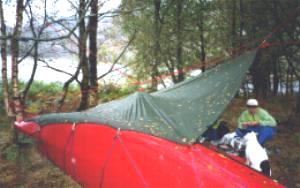 The
combination of tarp, canoes and bivis worked well. The camp site
was "open plan" with plenty of head room. There were none of the
hassles of getting in and out of tents. It also saved on the weight
of a tent. Might be different in midge season though.
The
combination of tarp, canoes and bivis worked well. The camp site
was "open plan" with plenty of head room. There were none of the
hassles of getting in and out of tents. It also saved on the weight
of a tent. Might be different in midge season though. 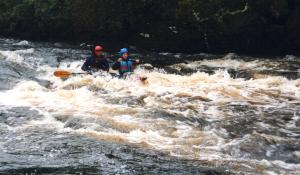 We
inspected the rapids about 2km above Killin before running them.
Wobble was on the other bank and eventually decided she could be
parted from her owners no longer. Just as the first boat was about
to set off Wobble jumped into the grade 2 water downstream and swam
(ferry glided) across to our bank!
We
inspected the rapids about 2km above Killin before running them.
Wobble was on the other bank and eventually decided she could be
parted from her owners no longer. Just as the first boat was about
to set off Wobble jumped into the grade 2 water downstream and swam
(ferry glided) across to our bank! 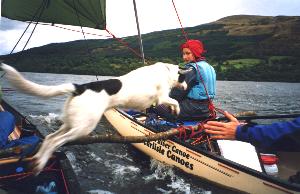 We
wanted a south westerly the next day to sail down Loch Tay. It duly
arrived and the tarp was rigged up. This was no ordinary tarp. Mark
4, it was very light with strong material, 3m x 3m, with fixings
for sailing and camp use. By Mark 5 or 6 it is hoped a model will
be commercially available. The canoes were rafted up using a 9m
length of wood, the sail hoisted and we did about 7km/hour down
the loch even being able to brew up an expresso for our elevenses.
We
wanted a south westerly the next day to sail down Loch Tay. It duly
arrived and the tarp was rigged up. This was no ordinary tarp. Mark
4, it was very light with strong material, 3m x 3m, with fixings
for sailing and camp use. By Mark 5 or 6 it is hoped a model will
be commercially available. The canoes were rafted up using a 9m
length of wood, the sail hoisted and we did about 7km/hour down
the loch even being able to brew up an expresso for our elevenses.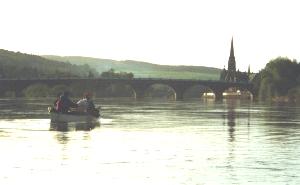 make
the leg to Dundee a tricky slog in wind against tide conditions.
At 9am we reached Perth and took out just above the first bridge.
make
the leg to Dundee a tricky slog in wind against tide conditions.
At 9am we reached Perth and took out just above the first bridge.


